
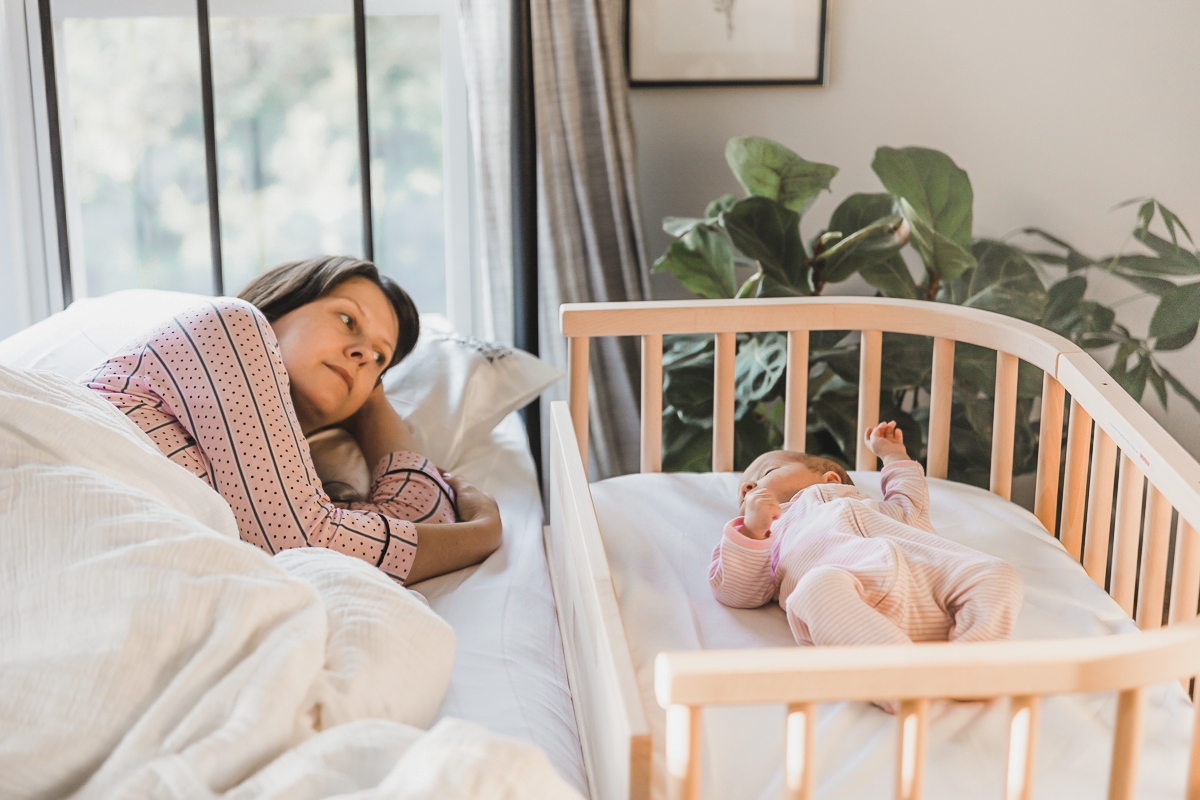
Picture this. It’s 3 a.m., the house is dead quiet, and you’ve just spent forty minutes rocking a baby who finally went limp in your arms. You bend over the crib, lower them down slowly, and their eyes pop open like you pressed a button.
Now you’re standing there in the dark, wondering if every parent goes through this.
Short answer, yes! But, there’s a gentler way through it.
It’s called sleep conditioning and it’s less fancy than it sounds. You’re helping your baby get used to sleep, little by little, starting in the first weeks. A calm room and a few repeated cues, plus some patience on your end.
Newborns sleep somewhere around 14 to 17 hours a day, only in short scattered chunks, so you’re really just learning their rhythm and going along with it.
Now, you might be thinking this sounds a lot like sleep training. Fair, because the names are practically twins. They’re different, though, and that’s coming up below, along with when most parents start and what a safe sleep space looks like.
Pour yourself a cup of something warm first. Nobody expects you to have this figured out tonight, and this will be the least of all your baby issues.
What Is Sleep Conditioning for Babies?
Be honest about how you wind down at night. Maybe it’s a hot shower, the lights turned low and a few pages of a book you never finish. Your body catches on, and by the time you’re under the blanket it’s already halfway gone.
Sleep conditioning does that same trick for your baby. You repeat a small, gentle pattern each day, and slowly they link it to rest.
Ever wonder why your baby treats 3 a.m. like happy hour? Their body clock isn’t finished yet. At first, sleep runs on hunger and comfort, and the sun gets no vote. Then around six to twelve weeks, day and night start to show up in their sleep, and by four to six months many babies sleep longer at night. Until that kicks in, you’re setting things up and keeping watch.
Until then, you’re setting the stage and watching for signs.
That’s why the routine has to grow with your baby. A two-week-old doesn’t need a schedule, and a five-month-old wants more than cuddles. So you adjust as you go, and you show up when they need you. The effort pays off, too: a 2023 analysis found that across 13 randomized trials, sleep support lengthened babies’ nighttime sleep and lowered mothers’ depression scores, though babies woke just as often.
How Is Sleep Conditioning Different From Sleep Training?
If sleep conditioning is learning to float, sleep training is swimming laps. One you can start with a brand-new newborn, since it’s all about gentle habits and a steady rhythm. The other is a more structured plan that teaches a baby to fall asleep without help, and it usually waits until your pediatrician says your baby is ready.
Here’s how the two stack up, side by side:
| What To Look At | Sleep Conditioning | Sleep Training |
| Main goal | Build gentle habits and a steady rhythm | Teach your baby to fall asleep without help |
| Typical start | Newborn weeks onward | Later, once your pediatrician agrees your baby is ready |
| Your role | Stay close and respond | Step back at set times, depending on the method |
| Crying | You soothe as it happens | Some methods allow short stretches of crying with check-ins |
| Pace | Slow, and it follows your baby | Structured, usually with a set plan |
| Main focus | Routine, environment and wake windows | A specific method and timing |
| Flexibility | Changes day to day | Works best with steady, repeated steps |
| Night feeds | You respond to hunger as it comes | May change night feeds if your pediatrician agrees |
| Timeline | Builds over weeks and months | Often a few days to a few weeks |
| Best fit | Newborns and new parents wanting a soft start | Older babies who are ready and still waking often |
When Should Parents Start Sleep Conditioning Their Baby?
Nobody hands you a calendar for this part, which is annoying and kind of freeing at the same time. Most parents start in the first days at home, and those first steps are almost silly in how small they are. Mostly you’re just noticing things.
Some babies are quick and some take their sweet time, so here’s what each stage tends to look like:
- Right from the newborn stage: Keep nights dim and days bright, and that’s honestly it for now.
- In the first few weeks: Notice when your baby gets sleepy and scribble it down.
- As early habits form: Pick one calming step, like a song, and repeat it until it feels familiar.
- When your baby seems ready: Add a bit more structure once nights start to settle, usually after the early months.
- Depending on your baby’s own needs: Some babies sleep long and some wake often, so lean on your pediatrician.
- Through small, slow changes: Tweak one thing, then wait about a week before you judge it.
5 Gentle Ways to Introduce Sleep Conditioning at Home
It’s 9 p.m., you’re wiped, and the internet just told you to buy a sound machine and a tracking app.
Take a breath and put the cart down.
A few small habits cover most of it, so pick whichever one sounds easiest tonight, try it for a few days and see what your baby does. Doesn’t fit your family? Drop it, guilt free, and grab another.
1. Run The Same Routine Every Night
Say it goes diaper change, feed, then the same little song you’ve now sung four hundred times. Keep it short, a few minutes tops. Your baby can’t understand a word yet, but by the second or third week that order starts to feel like a signal, and you’ll swear they’re rolling their eyes when you skip the song.
2. Make The Room Boring On Purpose
Dim the lights and keep the room a little cool and quiet. The neon mobile can wait. A dull room sends a clear message: this is where sleep happens. Bonus for you, the 2 a.m. feed goes smoother when you aren’t squinting at a lamp that could land a plane.
3. Spot The Sleepy Signals Early
Newborns have a tiny window before everything falls apart. Watch for yawns, that faraway stare or arms jerking around, then head for the crib right then. Catching it and settling takes a minute. Miss it and you’re negotiating with a very loud, very overtired person who has zero interest in your plan.
4. Go To Them When They Fuss
When the fussing starts, show up. A hand on the chest, a soft shush or a slow sway usually does the trick before you lay them down. Go ahead and answer quickly, because a newborn can’t be spoiled. What they pick up is that someone’s here, and that feeling is what lets them drift off.
5. Teach Them What Day And Night Mean
Daytime is for open curtains, chatting and the vacuum running like normal. Night is for whispers, low lights and feeds with zero small talk. After a few weeks of that contrast, plenty of babies start pushing more of their sleep into the night, which you’ll notice the first time you wake up at a normal hour.
What Does a Healthy Sleep Environment Look Like for Newborns?
This is the one place where you get to be strict with yourself, because safe comes before cute!
A 2026 CDC report on 4,861 sudden unexpected infant deaths found that 73% involved unsafe sleep factors, and two out of three babies were under four months old.
The good news is that the fixes are simple and cheap. Here’s what a safe setup looks like:
- A firm, flat surface: Choose a mattress that doesn’t dip, covered with a fitted sheet and nothing more.
- An empty crib: Leave out plush toys and loose blankets, since more than three out of four of those deaths involved soft bedding.
- Back to sleep, every time: Lay your baby on their back for every sleep, naps included.
- A comfortable temperature: Use light layers, avoid overheating and ask your pediatrician what suits your home.
- Sharing your room: Pediatric guidance suggests room sharing, but not bed sharing, ideally for at least the first six months.
- The other safe habits: Skip inclined sleepers and sofas, and avoid falling asleep with your baby on you when you can.
How Can Parents Tell If Their Baby Is Developing Healthy Sleep Habits?
Here’s a fun fact nobody mentions at the baby shower: the first sign of healthy sleep is usually a tiny improvement. Your baby falls asleep a bit quicker after a feed. The longest stretch at night goes from two hours to three. Evenings stop feeling like a siege. You’ll probably spot these only in hindsight, but they count, even when the night still drags.
Zoom out and watch the whole day, too. A baby who wakes up alert and content, feeds well and enjoys calm, awake time is most likely getting enough rest. Sleep keeps shifting over the early months, and nights stretch out as your baby’s internal clock grows up. So if this week is a mess, shrug it off. A rough week doesn’t undo the good ones.
Now for the part that’s worth a phone call. Call your pediatrician if your baby is hard to wake for feeds, feeds poorly, or seems unusually fussy or limp, and also if breathing or weight has you worried.
Keep a simple log of sleep, feeds and diapers for a few days first. It gives your doctor real details to work with, and it’s oddly satisfying to fill in.
Explore How Sleep Conditioning Can Support Your Parenting Journey With TeeCee Family Nest!
Version 1
So, back to that 3 a.m. nursery. The swaying, the yawning and the endless questions all come with the territory, and none of it means you’re doing something wrong. Sleep conditioning gives you a gentle way to build good habits from the start, using a safe space and a few steady routines. You don’t need to wait for a magic age, and you definitely don’t need to do it alone.
If you’re in Hoboken or Jersey City, TeeCee Family Nest offers gentle, personalized newborn sleep support for local families. The team starts by studying your baby’s natural sleep patterns, then helps set up a calm sleep space and simple, realistic routines around your household. Harsh or stressful techniques stay off the table, and the focus stays on responsive care that respects your baby’s emotional and developmental needs.
- Looking closely at your baby’s natural sleep patterns
- Setting up a calm sleep space and simple, realistic routines
- Responsive, age-appropriate care without harsh methods
Ready for some calmer nights? Or want a calmer bedtime, maybe even this week? Take a look at sleep conditioning and get in touch with TeeCee Family Nest, do not forget to book through the client portal, call or email. Mention how old your baby is, how bedtime goes right now and which stretch of the night is the roughest. The team can then talk you through a plan that suits your home.
Frequently Asked Questions (FAQs)
Q1. When should parents start sleep training?
Most pediatric advice says to wait until the early months are behind you, often around four to six months, and to get a go-ahead from your pediatrician first. Every baby runs on their own schedule. Before that point, steady routines and a safe sleep space do the heavy lifting.
Q2. What is the 5-3-3 rule for sleep training?
Short answer: it depends who you ask. People use “5-3-3” for timed check-ins, for sleep and awake hour patterns and more, and none of it counts as a medical guideline. Ask which version someone means before you try it. You can build solid sleep habits without staring at a clock, and your pediatrician is the right person to help you pick what fits your baby.
Q3. When should I introduce a sleep routine to my baby?
Sooner than you’d think, and in a smaller way than you’d guess. Nothing fancy. In the first weeks at home, a quick diaper change, a feed and a quiet song in the same order is plenty. Skip anything strict. A newborn mostly wants predictability, comfort and a safe place to sleep, and the routine can grow with them over the next few months.
Q4. What are the differences between sleep training and not sleep training for babies?
Picture two parents at the same playground. One follows a plan to teach independent sleep, usually when the baby is older. The other keeps responding and lets sleep develop with time, routine and a good setup. Both approaches are valid, and plenty of families mix them.